


Both airsoft and paintball share the same core principle: to shoot and not be shot. Look a bit closer, though, and you’ll find some significant differences between the two sharp-shooting sports. Read on to discover the key differences between airsoft and paintball.
Definitions
Both sports share the main objective to eliminate the opposition by shooting them with your gun (or marker, in paintball’s case). The definitions below, however, emphasise the sports’ main differences.
Paintball
Paintball is a sport that can be played alone or within a team; the objective being to eliminate your opponents by hitting them with your paintballs. It’s easy to distinguish players who’ve been hit as paintballs pop when they hit something, leaving a clear paint mark on the target.
Airsoft
Airsoft is a team sport with a defined set of goals. Players shoot plastic pellets via replica firearms to eliminate their opponents. However, as there’s no obvious lasting mark from being hit with an airsoft pellet, it’s underpinned by an honour system which means that players are required to admit when they’ve been hit.
Clothing and equipment
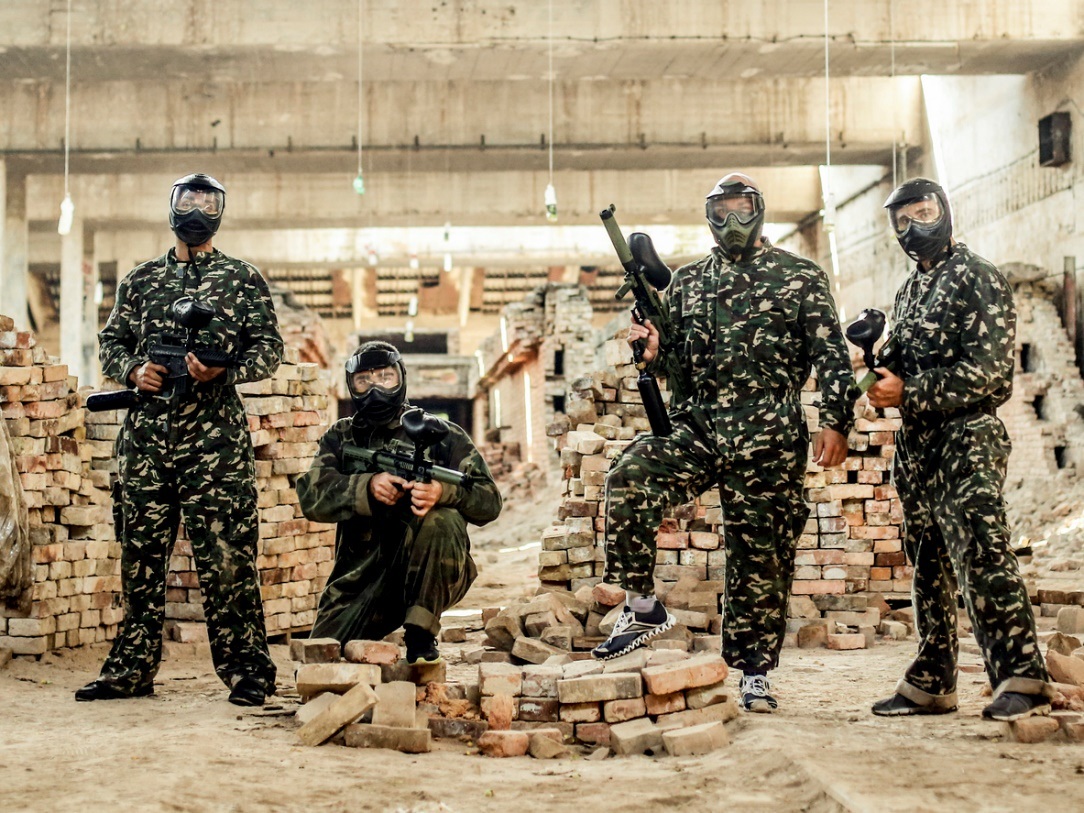
While
camouflage is a firm favourite in both airsoft and paintball, dress
codes for each game can vary depending on the game mode being played.
Firstly, paintballers
tend to don full face masks and overalls while wearing old clothes
underneath.
Airsoft
players often wear overalls too, however, tough boots are also
advised to tackle wet, muddy terrains.
In
airsoft, tactical
goggles
are often worn, while half-face
masks
are more common as there is no risk of paint exploding in a player’s
face/mouth.
Guns
Paintball
Paintball guns -
also known as markers - are the main piece of paintball kit. They
use expanding gas (e.g. CO2) or compressed air to propel
paintballs through the barrel and towards their target. The muzzle
velocity of paintball markers is approximately 90 m/s
(300 ft/s), however, most paintball sites restrict it to 280
ft/s.
Markers are
comprised of a barrel, hopper and air tank, so there’s a lot less
that can go wrong with these guns than their airsoft cousins. Their
simple design doesn’t compromise when it comes to power, however.
When paintballs hit a body part for instance, they can cause damage
such as bleeding, bruising; and in extreme cases, muscle tissue
damage. While such occurrences are rare, paintball
players must wear masks
at all times to
protect their eyes, mouth, and ears.
Airsoft
Airsoft guns utilise one of three main operational methods: electric, spring and gas powered. In terms of aesthetics, airsoft guns are split into two categories, realistic imitation firearms (RIF) and imitation firearms (IF). To the untrained eye - and in some cases, even trained ones - military-focused RIFs are indistinguishable from real firearms due to their 1:1 scale replication. IFs, on the other hand, feature brightly coloured two-tone paintjobs that clearly set them apart from real firearms and RIFs.
Ammunition
Paintball
Paintballs aren’t actually made from paint, they’re actually spherical gelatin capsules containing polyethylene glycol, dye, and other non-toxic water-soluble substances. They’re also significantly larger than airsoft pellets, the most common size measuring 17.3mm, compared to the standard 6mm airsoft pellet. Unlike the realistic mechanisms found in airsoft guns, marker ammo is fed through a hopper and requires user input to load the balls into the gun’s chamber. The price of 500 paintballs is approximately £15.
Airsoft
Airsoft pellets
usually measure around 6mm-8mm in diameter and weigh between
0.12g-0.48g; the most popular size being 0.12g, 0.20g, and 0.25g.
Pellets at the lighter end of the spectrum achieve
greater speed, however, they lose this speed quicker than heavier
varieties, while they’re also prone to losing accuracy in adverse
weather conditions. On the other hand, heavier pellets gain more
momentum, making the pellet strike the target at greater velocity,
while accuracy may also be improved due to the increased weight.
As
mentioned above, airsoft
pellets are loaded through a
traditional gun style magazine, increasing their realism. The
magazine construction also tends to be less fiddly than the marker’s
equivalent, and ammo is therefore less likely to spill out.
Airsoft
pellets are much less expensive than paintballs, and you can pick up
2000
pellets for as little as £3.99.
Rules
Paintball
In paintball, a
solid mark will be left where the player is hit, and this indicates
that the player is out of the game. Players who’ve been hit must
exit the field and head to the dead zone as quickly as possible. They
can make it known they’ve been hit by holding their gun above their
head.
Sometimes
however, nearby paintballs break and spatter; this will not count as
a hit. To be sure, players can ask for a paintball check from a
teammate. The game will temporarily cease while this occurs. ‘Game
on’ is to be shouted when play is ready to resume.
Additionally,
players must not:
- Venture outside of the designated boundaries
- Fire ‘blind’
- Shoot too close to an opponent; or overshoot
- Remove their masks on the field
Airsoft
Airsoft games
rely on the honour system - players must admit when they’ve been
hit as there’s no evidence of the fact. To comply with the honour
system, a player must shout ‘hit’ while holding their arms aloft.
Players are then not permitted to play until they respawn or get
tagged in.
These rules vary
from site to site and the details will be explained to you before the
game begins. Another noteworthy point here is that players can also
be ‘killed’ by explosives. For example, a player within close
proximity of a detonated grenade will be eliminated.
Field Roles

Field roles are
typically more prominent in airsoft due to the game’s realism and
stricter regulations. An airsoft team tends to include - but is not
limited to - the following roles: team leader, sniper, support
gunner, rifleman, and medic.
Paintball, on the
other hand, tends to leave out complex tactics to focus on the sheer
pace of the game, reducing the need for designated roles. Think of it
like football - airsoft is like an 11 a-side match whereas
paintball resembles the chaos of 5-a-side.
Cost
As we’ve seen above, airsoft ammo is significantly cheaper than paintball ammo. On average, paintball costs more to play than airsoft, however, it’s widely accessible in the UK. Also, as British airsoft sites are considered to lead the sport globally, players can rest assured they’ll be getting the very best for their money.
Does airsoft hurt more than paintball?
Anecdotal evidence indicates that airsoft pellets hurt a lot less than paintballs; a hit from an airsoft pellet is said to feel like an elastic band pinging against your skin. Those with a low pain threshold should not be deterred, however, as both sports offer mercy options to reduce the likelihood of experiencing physical discomfort and pain - e.g. players cannot shoot at an opponent within 10 feet.
Other differences
Paintball generally receives more sponsorship funds than airsoft and tournaments are considered extremely important, while paintball tends to be faster paced and less focused on objectives.
In terms of game variety, airsoft presents many more play options than paintball, and airsoft guns are much more diverse, inspired by games, films and tv - and even real-life armies.